
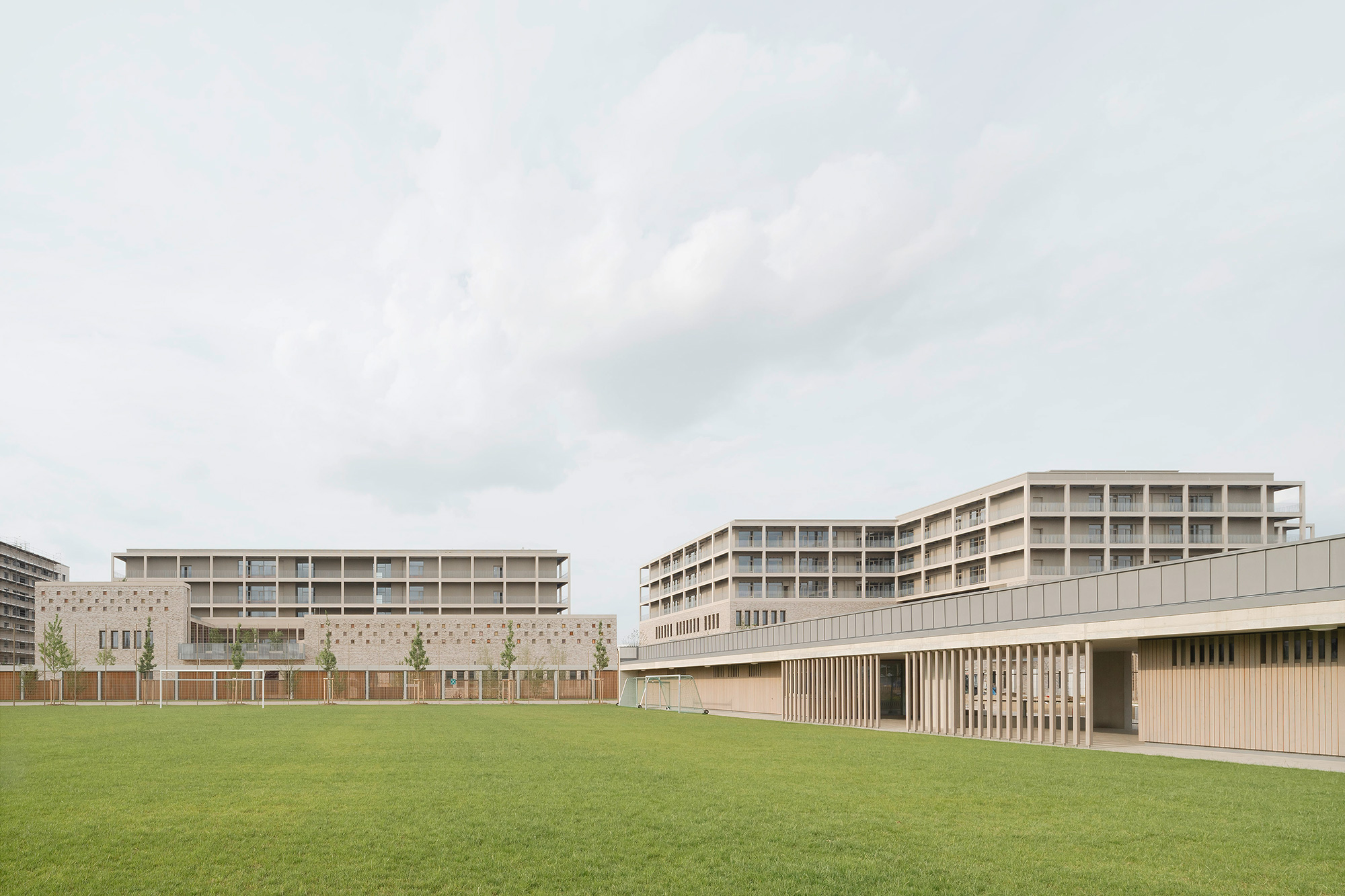
The completion of the Neufreimann Education Campus marks one of the first key milestones in the development of Munich’s new Neufreimann district. The extensive room schedule of the school complex ranges from a childcare centre to an attached six-form primary school and a six-form secondary school. The ensemble also includes a canteen, two caretaker flats, an underground car park, two sports halls, a swimming facility, and outdoor sports areas for both schools and local clubs. Around 2,500 people, including some 2,000 children and young people, use the new building – which essentially comprises two structures – as their daily place for learning, working and spending time. By systematically stacking the various functions, it was possible to accommodate the extensive spatial requirements within the two designated building plots.
For nursery children, pupils, educators and teaching staff, the new Neufreimann Education Campus creates a learning, social and working environment with very short routes. The Education Campus is a key social component of the new Neufreimann district in the north of Munich, currently being developed on the site of the former Bayernkaserne barracks. After the last military facilities vacated the site at the end of 2011, the architectural firms Max Dudler and Hilmer & Sattler und Albrecht won the urban planning competition in 2014. Development of the new urban quarter began in 2019 and, upon its planned completion in 2030, it will provide housing for up to 15,000 people. The master plan draws on Munich’s Gründerzeit districts with perimeter block development and a very high density. A “green axis” running diagonally through the site divides the neighbourhood and, together with the Green Boulevard, forms the spine for public and social facilities, including the schools in the north and south.
A new school typology – the urban cluster school
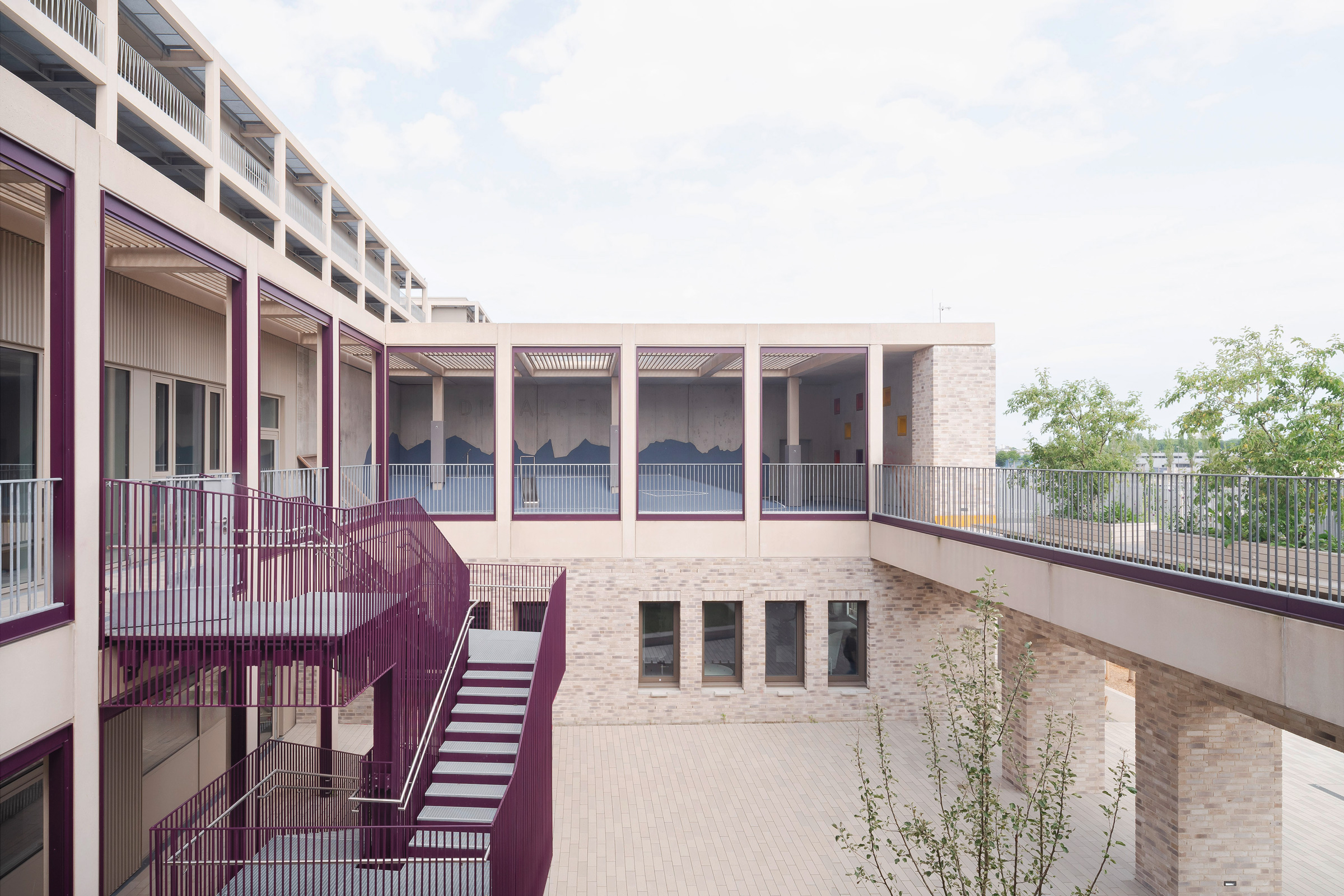
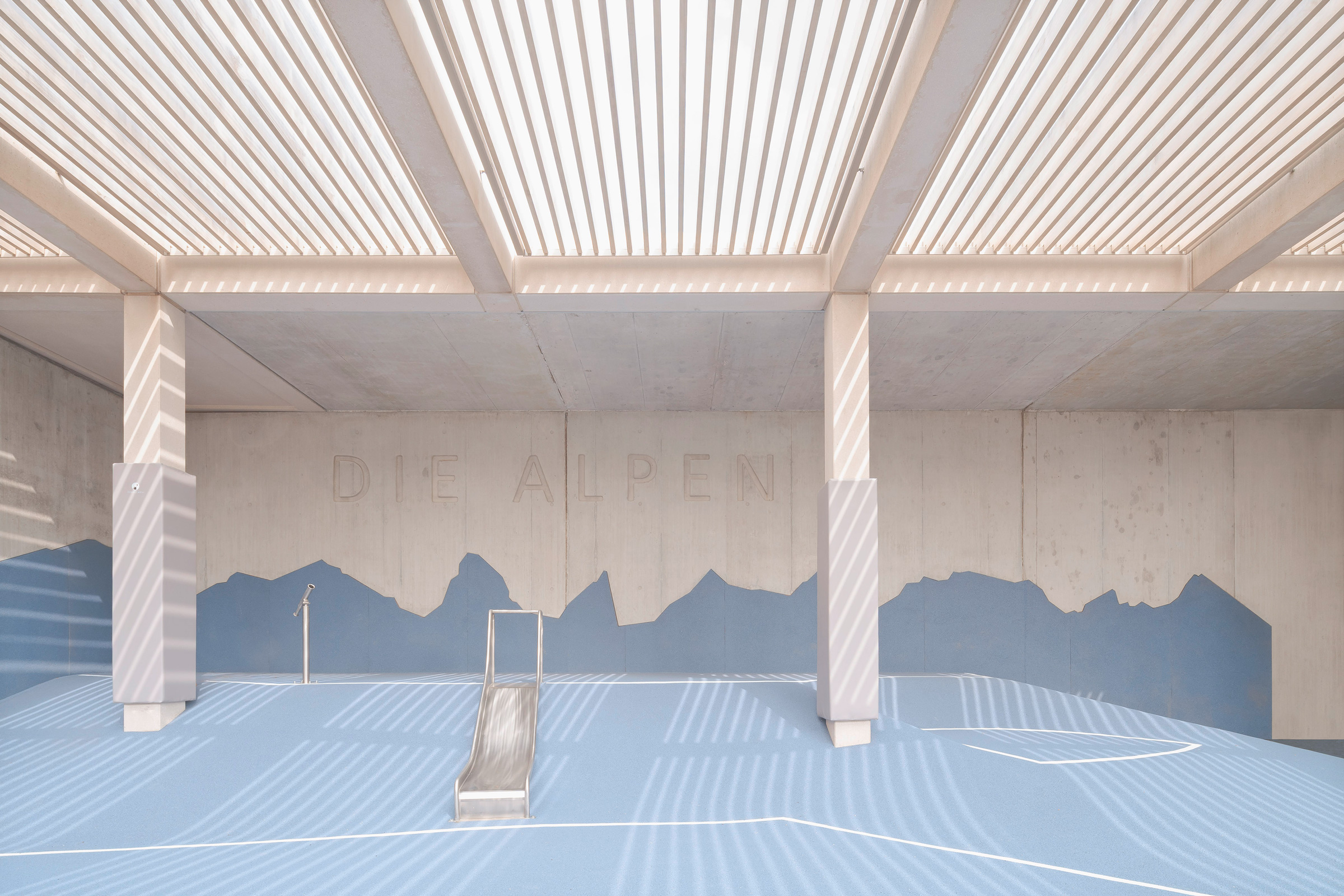
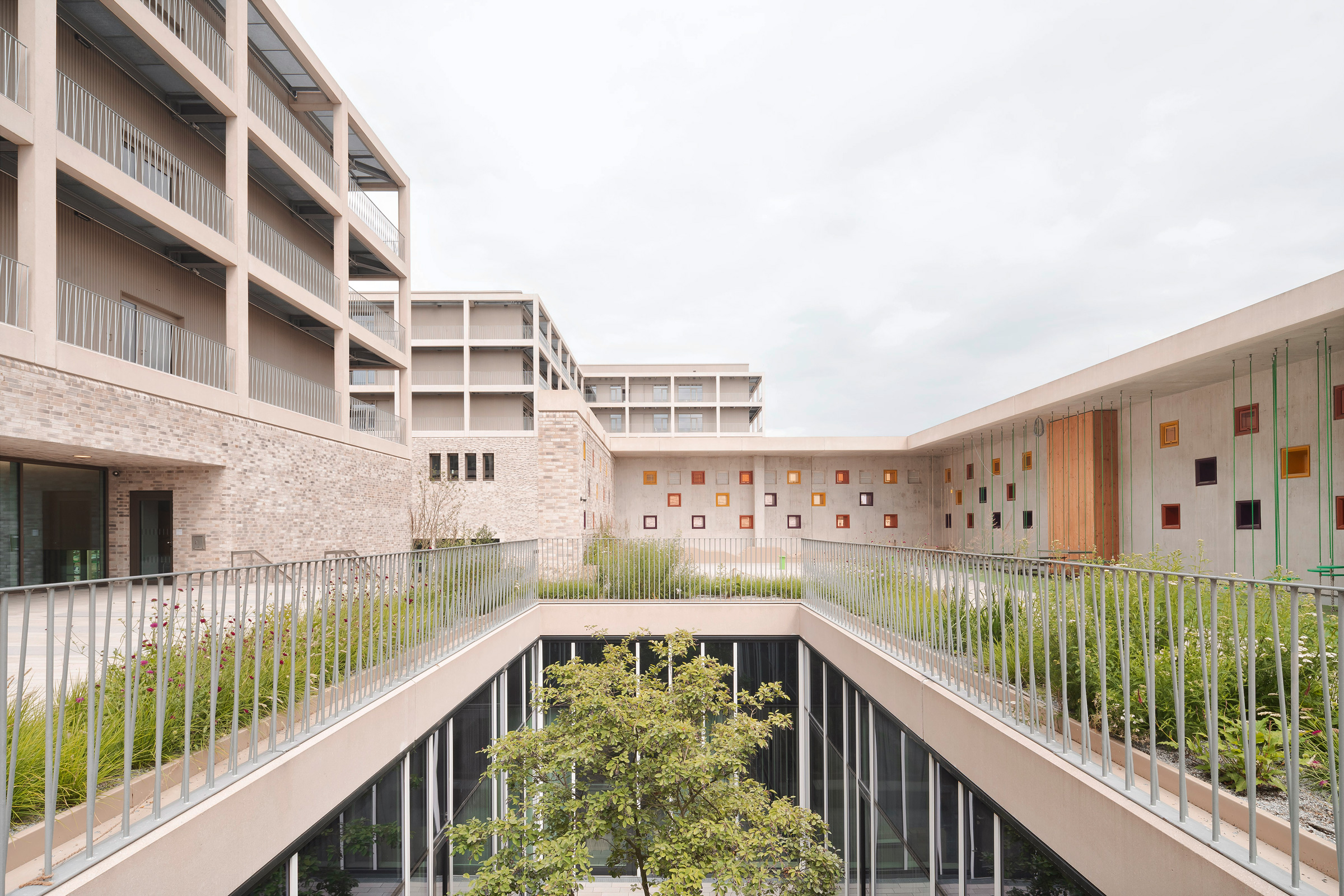
Due to the high urban density and the extensive spatial requirements of the schools, the Neufreimann Education Campus South fully occupies two urban blocks. The aim of the design was to achieve, despite this density, an innovative school complex with high-quality interior and outdoor spaces, while optimally implementing Munich’s “Lernhaus” concept. A new, urban and extremely compact type of cluster school has been developed, in which the functions are stacked vertically. By carving out specific sections from the building volume, open spaces are created through a process of subtraction. The interplay between enclosed and open spaces is a defining feature of the campus, where interior and exterior spaces are given equal importance. Roof terraces and outdoor areas serve as green spaces for learning and recreation, extending the interior spaces both functionally and spatially.
A unique model within Germany’s educational landscape
The school campus is characterised by a density of diverse uses that is unique in Germany to date, bringing together educational facilities, community sports and public institutions. The overall ensemble of the campus, with its short distances, will have a lasting social and developmental impact. Children can attend the nursery here from a very young age and complete their school education right up to the Abitur (A-levels) at the same location. In addition, sporting and cultural activities such as swimming, football and theatre are available under the same roof. The opportunity to access educational and leisure facilities from early childhood through to adulthood within a single building complex represents a new standard of quality, which is reflected in the high-quality architectural and open-space design.
Two school buildings, one shared campus
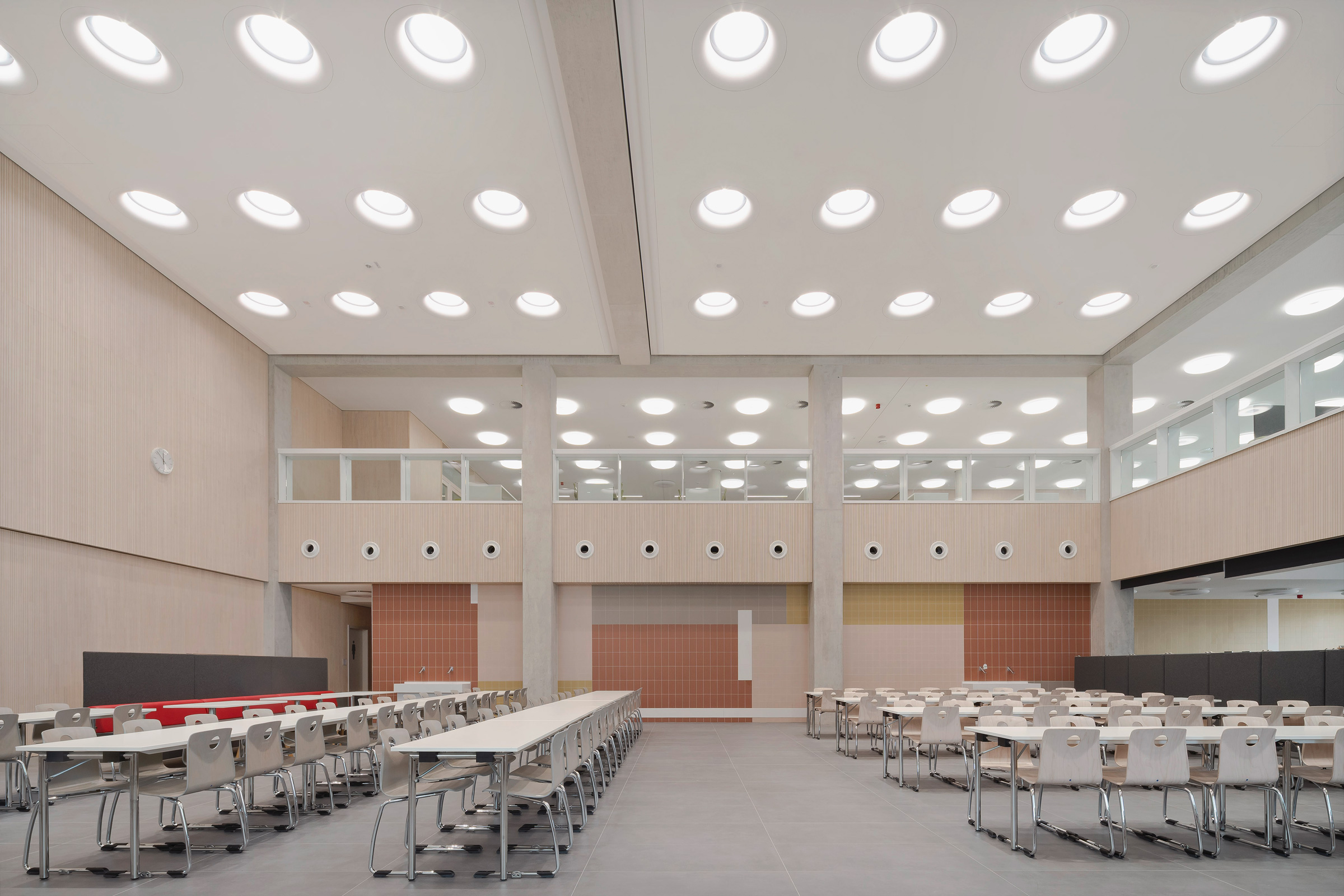
In both school buildings, the “public” functions are located within the two-storey podium levels. In the primary school to the west, these include the shared canteen, administrative areas and a two-court sports hall with a separate entrance for local clubs. In the secondary school to the east, the podium accommodates an assembly hall with adjoining library, administrative areas, a three-court sports hall and a swimming facility with an Olympic-standard 50-metre pool. To accommodate the varying ceiling heights, the sports halls are positioned on level -1.
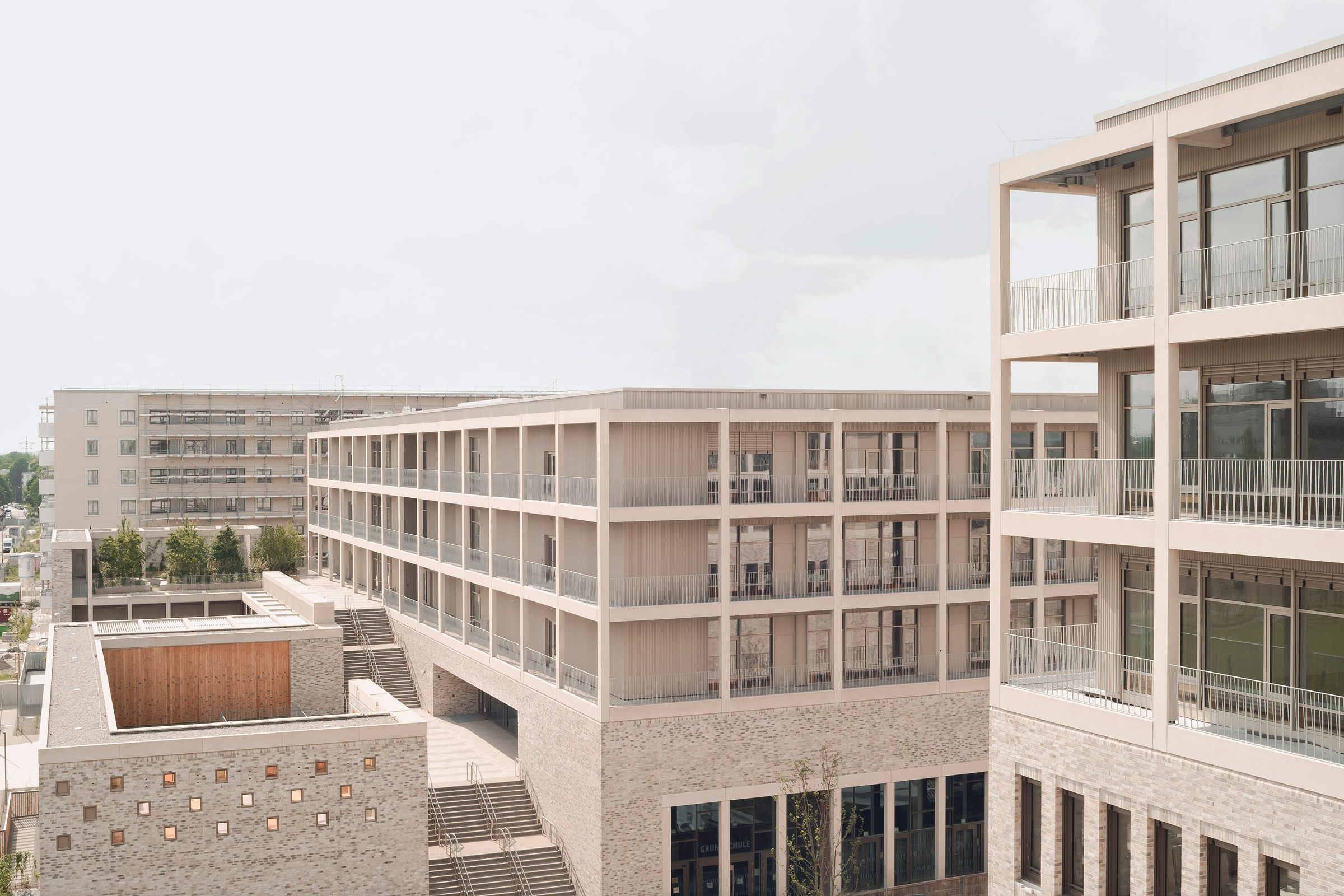
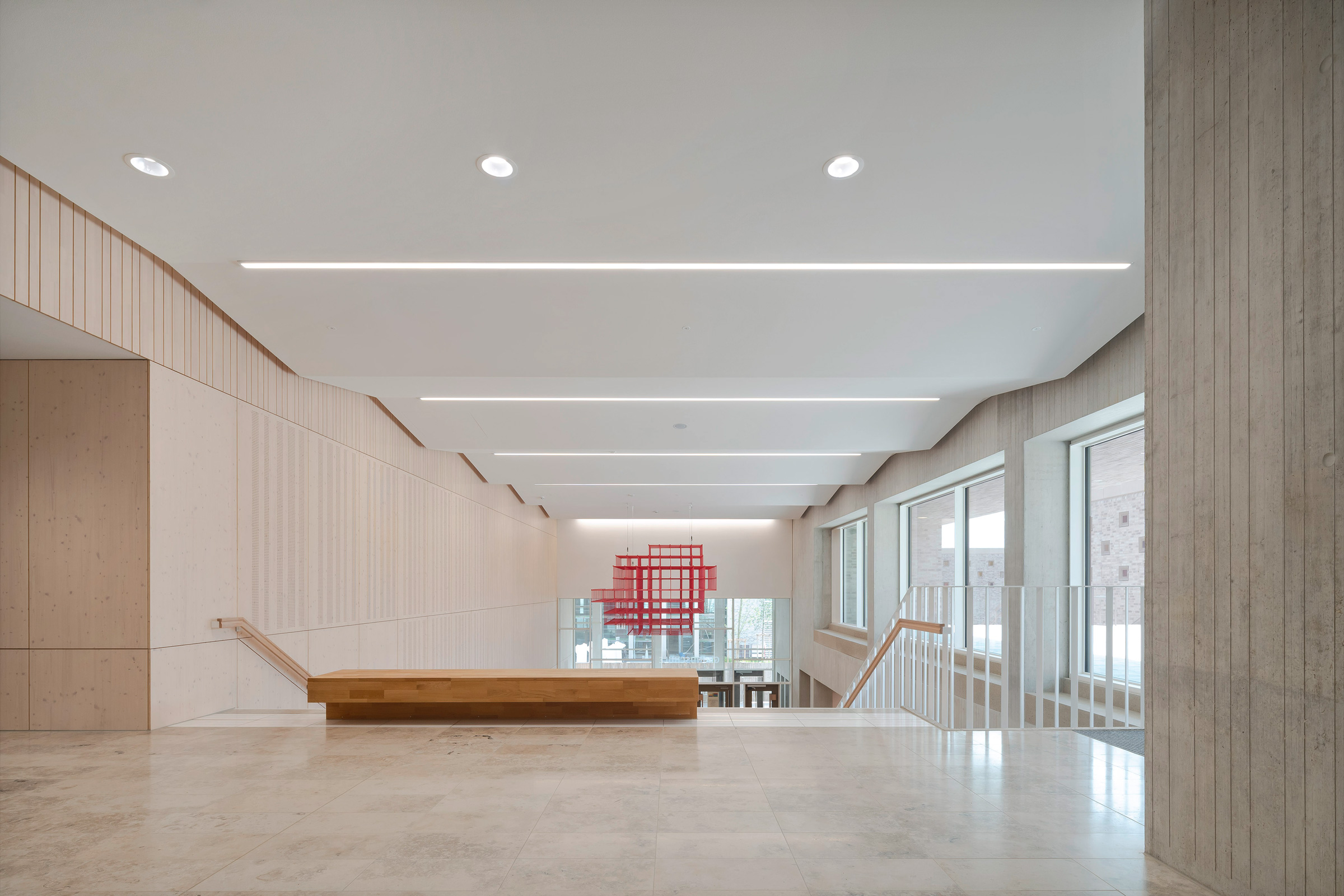
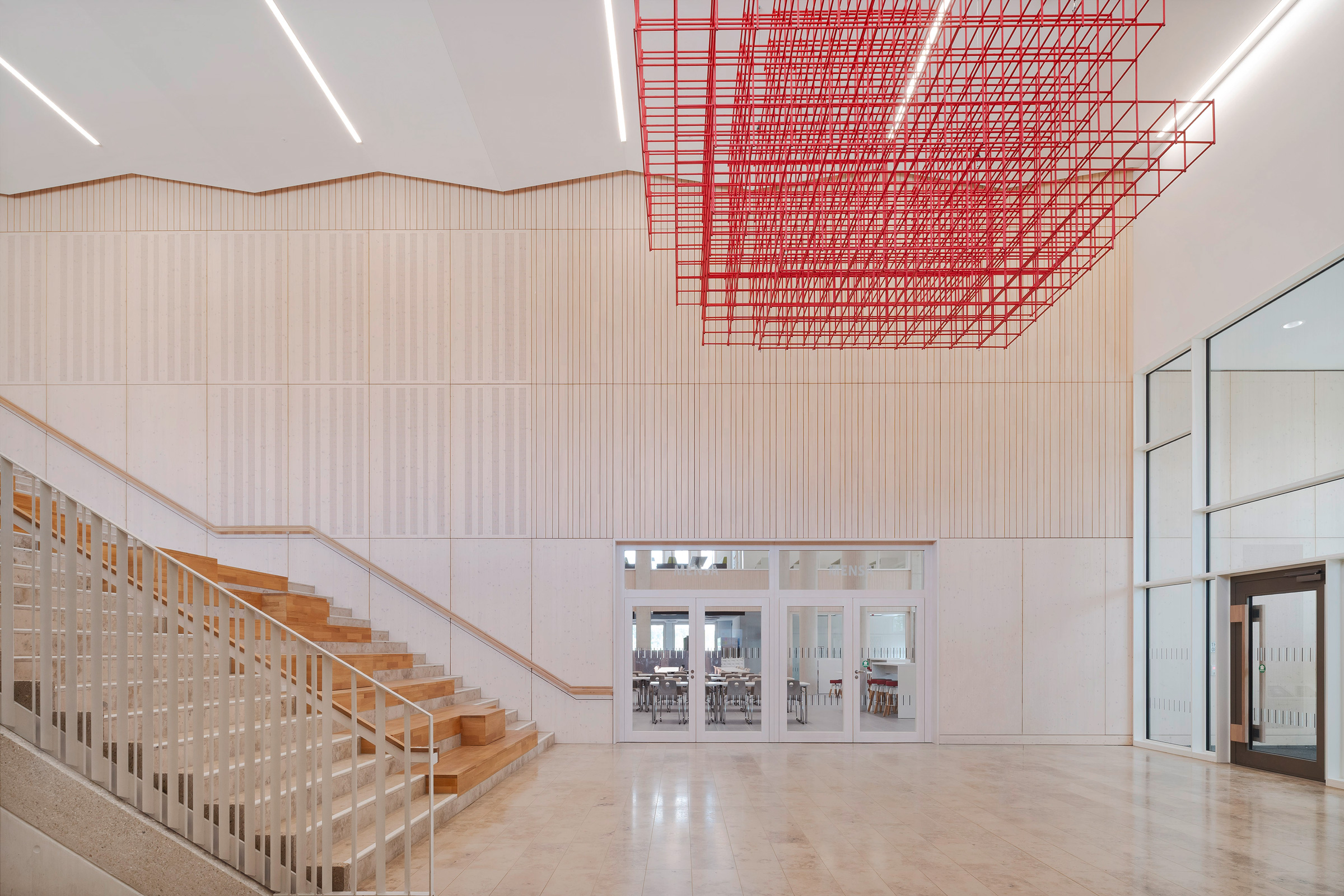
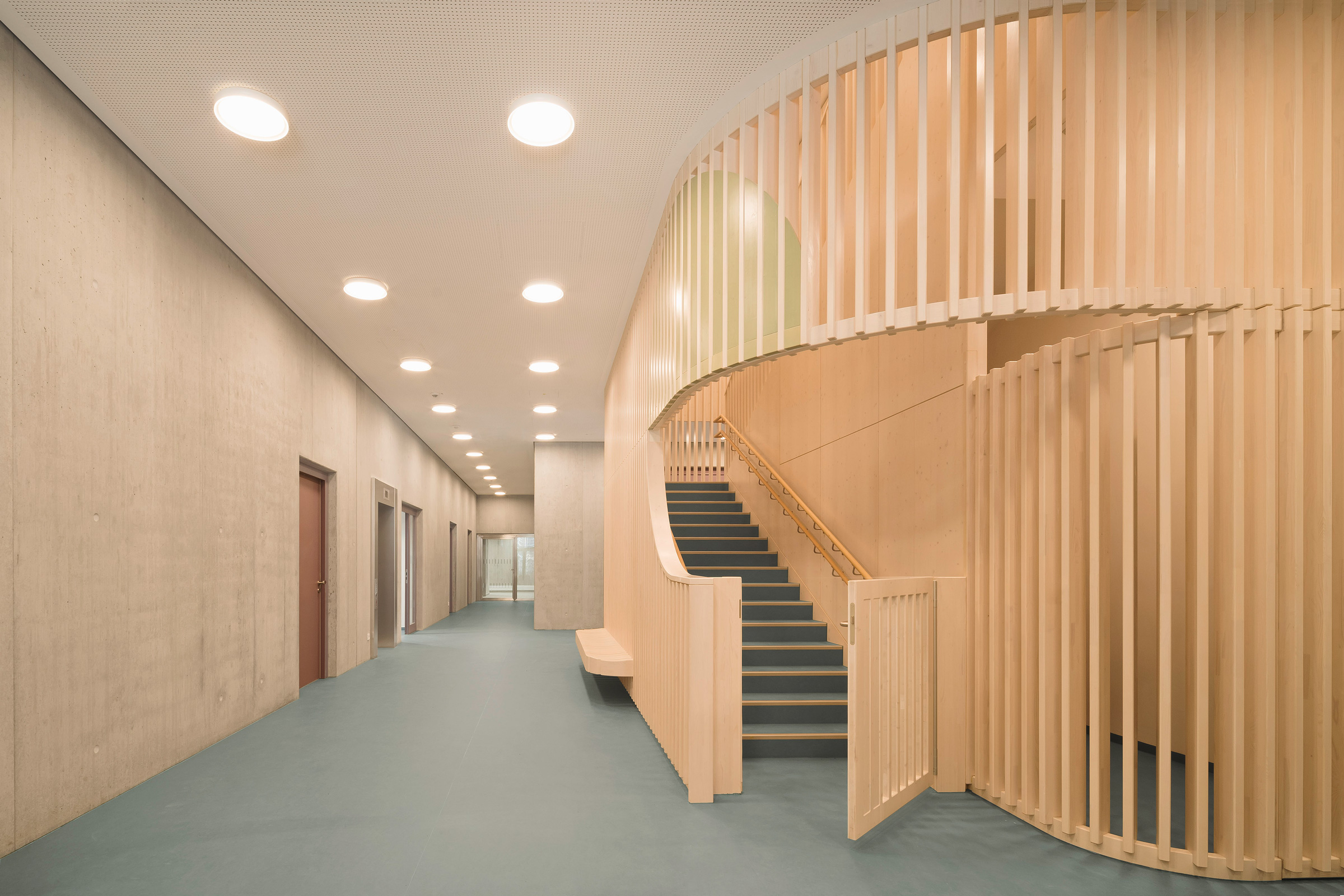
In both schools, spacious foyers with seating steps lead up to the learning areas on the upper floors. They form the spatial centre of each building, with their significance further emphasised by the art installation “Clouds” by Albert Weis. A shared access path connects the two schools, intersecting with the “Green Lane” and serving as a central hub for communication and interaction. By sharing the canteen, assembly hall and other facilities, the two institutions operate as a single, interconnected campus. To the south of the primary school is a two-storey childcare facility with its own dedicated entrance and outdoor area.
Robust interior architecture
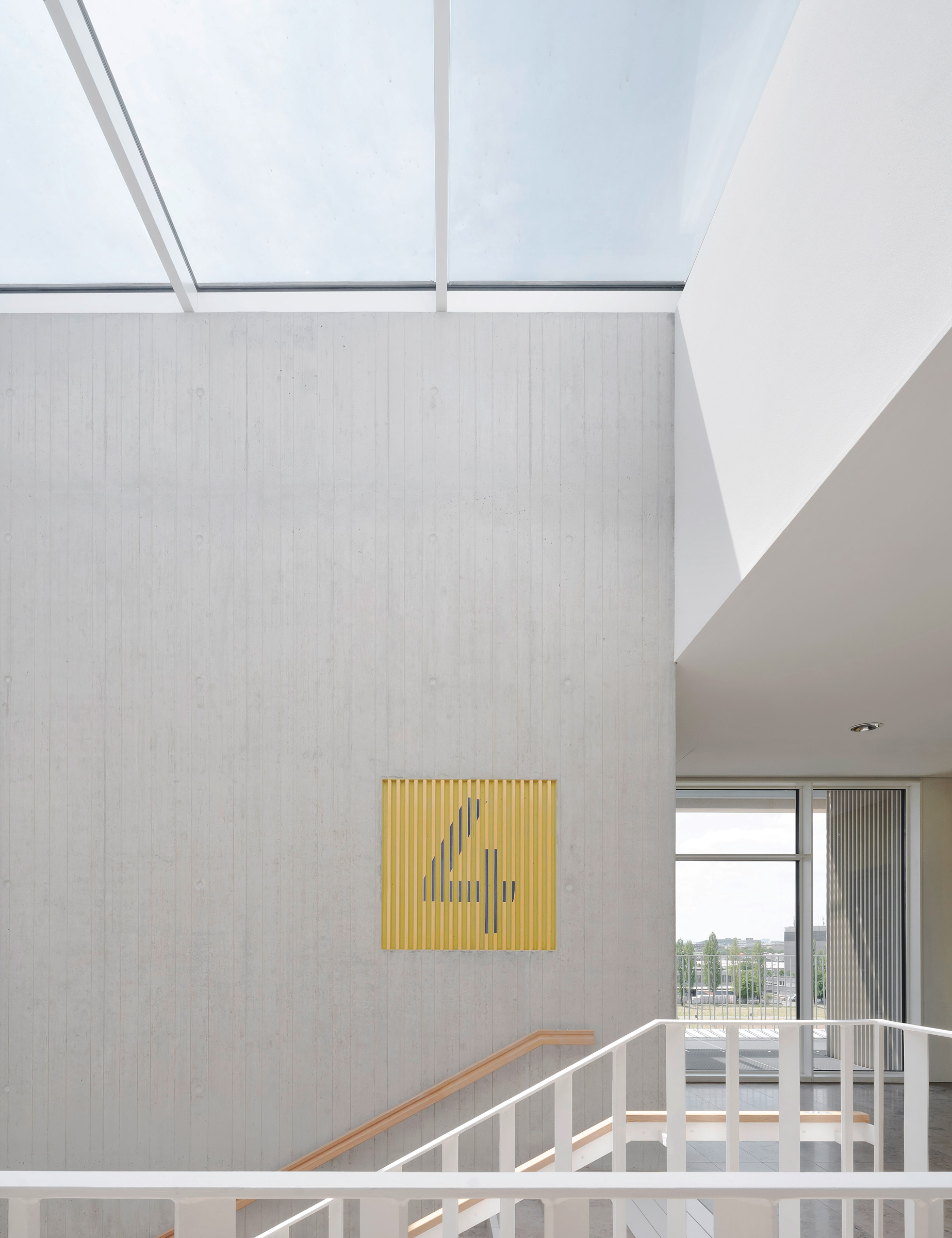
Above the respective podium levels, so-called learning ateliers are arranged as contemporary learning and communal environments based on Munich’s “Lernhaus” concept. Individual year groups are organised as independent clusters, with an open multifunctional area at their centre. Short routes connect the learning cluster with the playground areas. Both schools operate as full-day institutions, a fact reflected in the high-quality and varied interior design. Exposed concrete, wood surfaces, coloured linoleum and tiles define the interior architecture and ensure long-term durability.
While the primary school with its learning ateliers comprises four to five storeys, the secondary school stacks its functions across up to six levels. This is because dedicated STEM areas – including chemistry and biology laboratories – as well as music and art rooms are accommodated between the podium and the learning ateliers. For the STEM spaces, some of which are lit only via courtyards, a special daylighting concept was developed that channels daylight down into the learning spaces across several storeys.
Compact architecture with a low ecological footprint
Thanks to the vertical stacking of functions, the Neufreimann Education Campus has a comparatively small physical footprint. A comparative study showed that, had the sports halls, swimming pool and canteen been accommodated in separate buildings – as is typically of conventional school developments – around 28,000 sqm of surface area would have been sealed, approximately 2.5 times that of the realised campus, which occupies 11,500 sqm.
A complex structural challenge
The vertical stacking of functions posed a challenge for the structural design. In both building sections – the primary school with childcare facilities and the secondary school – only the lift cores run continuously through all levels. It took around two years to finalise the spatial layout and resolve the structural system. For example, three additional storeys containing the learning clusters are positioned above the secondary school’s triple sports hall, which spans considerable distances. To calculate building oscillations, the Technical University of Kaiserslautern was specifically involved in the planning process. For the structural engineers at BWP Burggraf + Weber from Munich, the School Campus South was one of the most complex projects in recent years.
The load-bearing structure consists largely of reinforced concrete combined with large-scale steel truss girders. In addition, the site of the former Bayernkaserne serves as a model area for testing circular economy strategies. However, the use of recycled concrete was not feasible for the School Campus South at the time of planning due to the high structural requirements. Looking ahead, recycled concrete is nevertheless expected to become a viable option, even for structurally complex projects.
High-quality façades and ecological construction
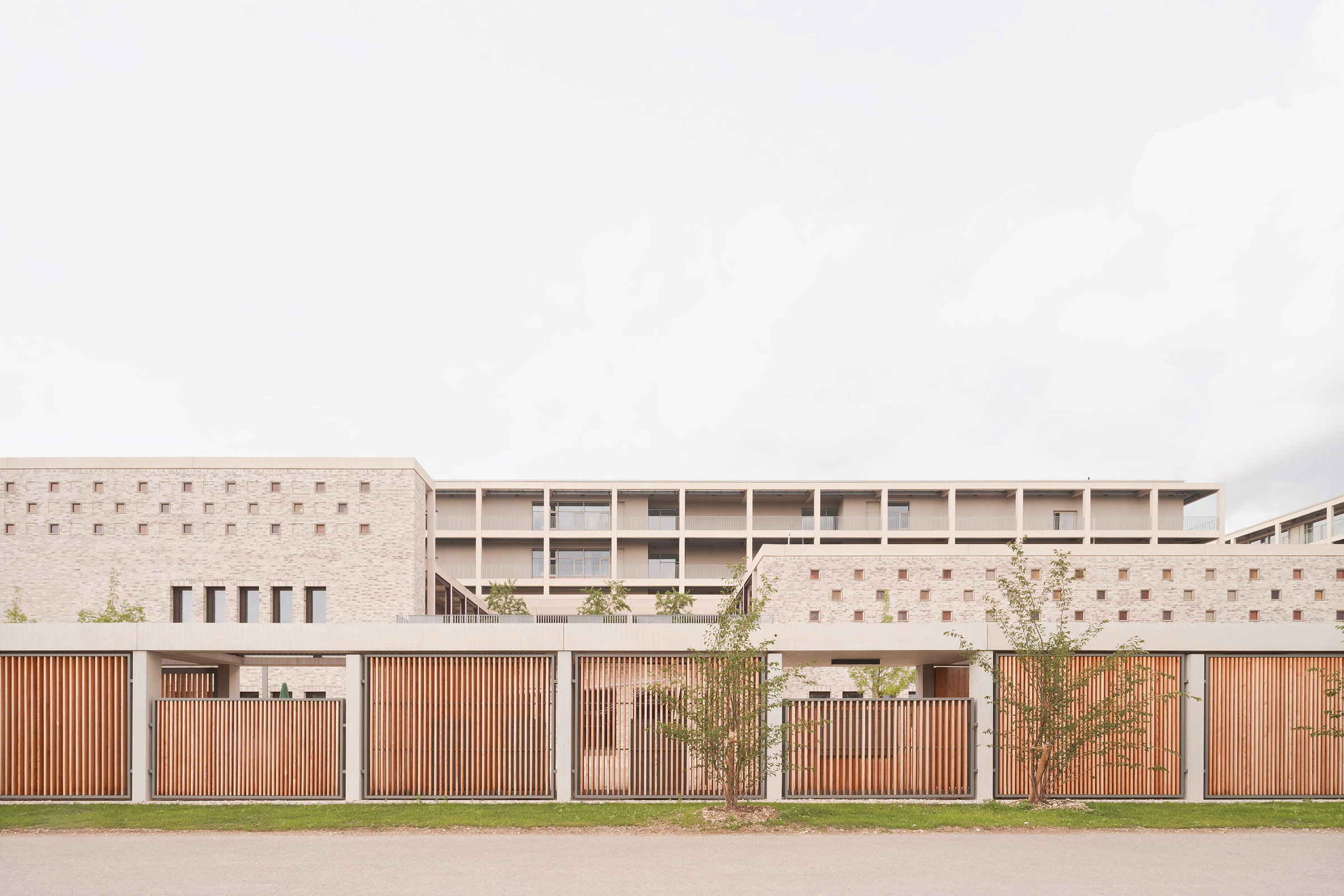
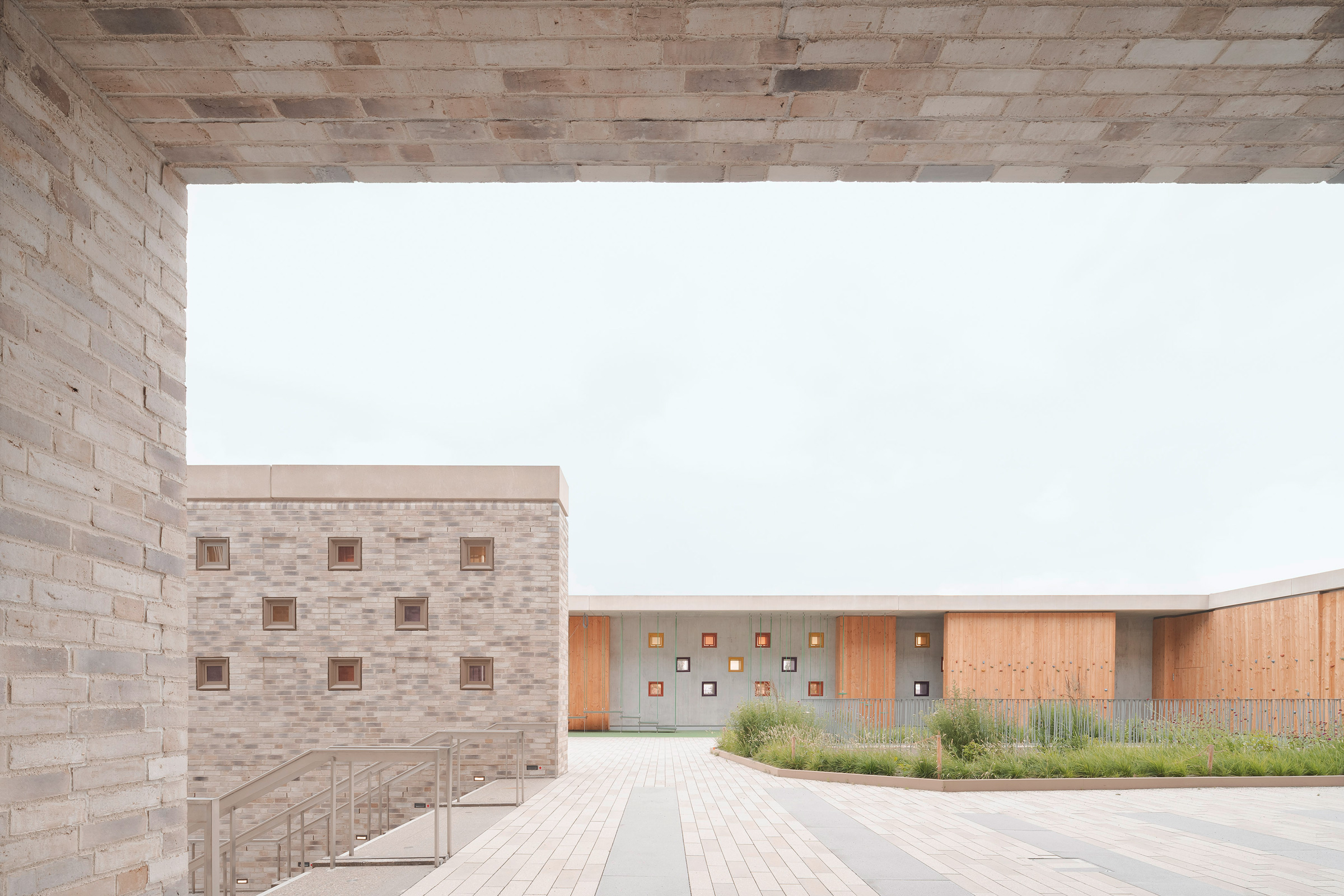
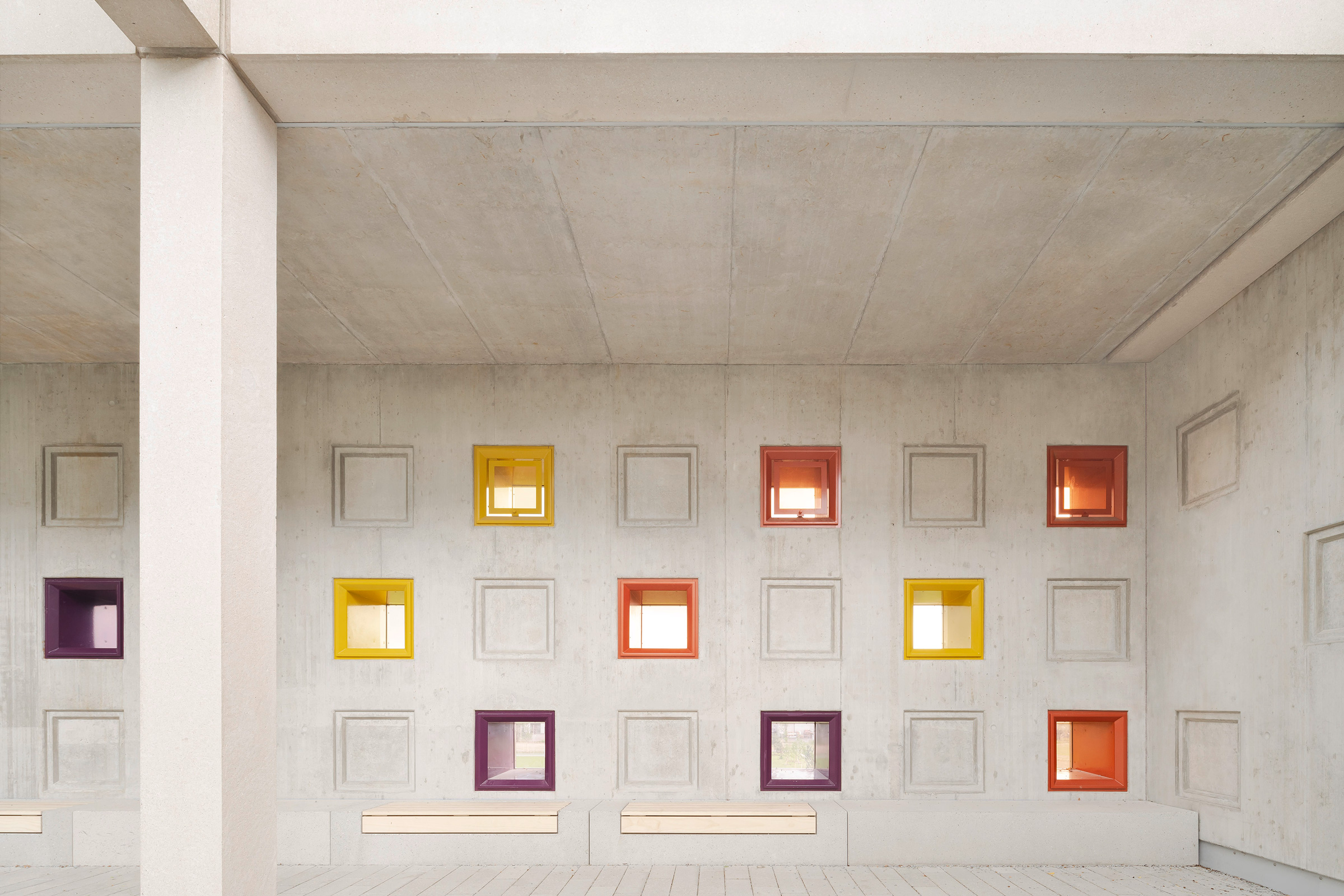
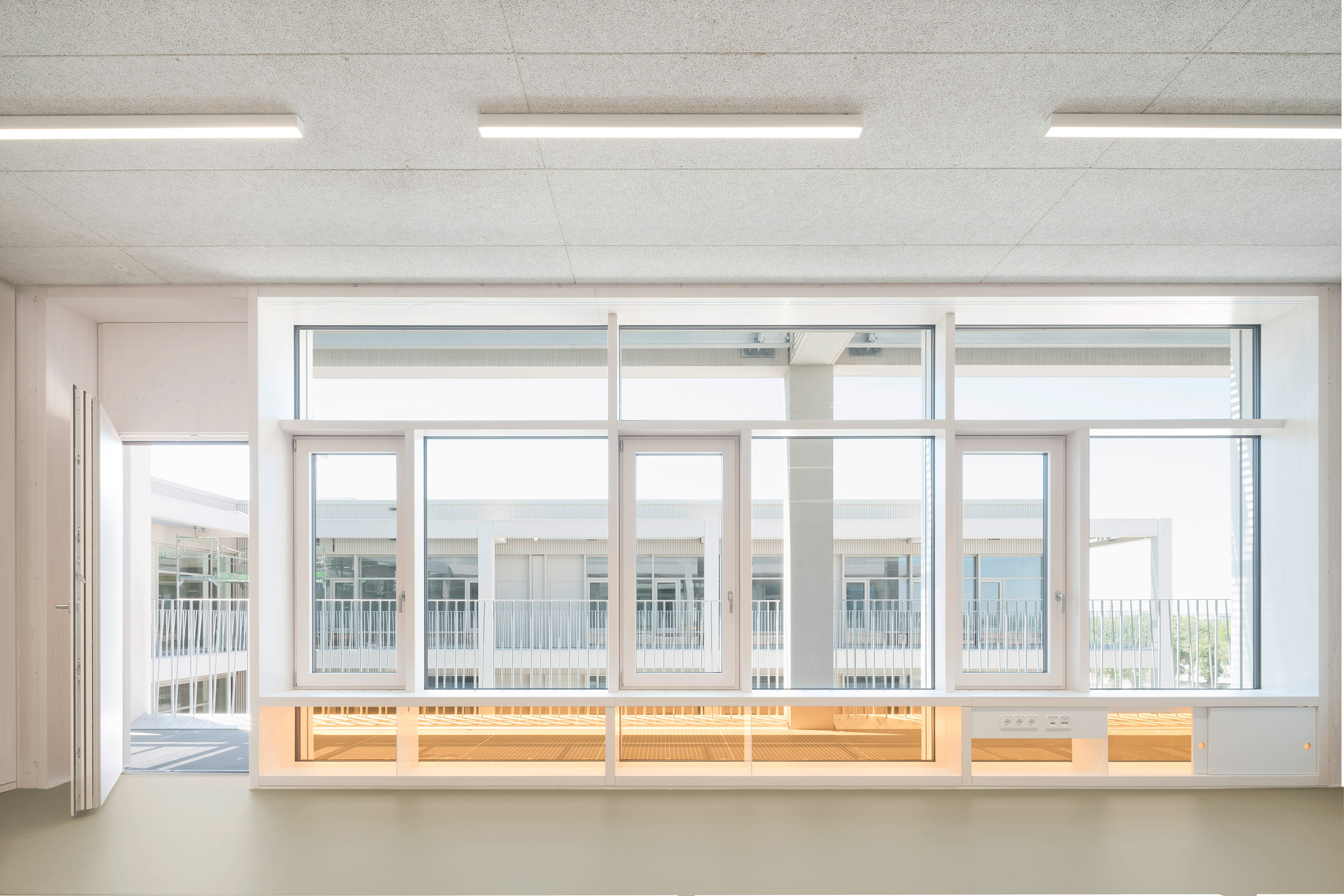
The façades of the podium levels are executed as rear-ventilated facing brickwork using light-coloured solid bricks. Openings and so-called light tubes with coloured glass inserts allow views in and out, while casting changing light effects into the courtyards. The learning ateliers located above are enclosed by a grid structure of white-tinted precast concrete elements, which accommodate escape balconies. Behind this structure, the thermal façades consist of large timber-aluminium window units with triple glazing.
The energy concept is based on a very low heating demand due to the buildings’ compact design. A high-performance building envelope, controlled ventilation with heat recovery, extensive use of daylight and photovoltaic systems on the roofs complement the concept. The education campus is connected to the district heating network of the new urban quarter and achieves energy efficiency class A+ in accordance with the German Energy Saving Ordinance (EnEV).